Why this article exists
If you've searched for a "log cabin shed" in the United States, you've landed in one of the strangest category gaps on the internet. Type those three words into Google and you get two wildly different products stacked on top of each other:
- Actual round-log cabin homes — real log houses priced from $50,000 to well over $500,000, built from peeled full-diameter timbers, aimed at people buying mountain retreats and vacation homes.
- European-style "log cabin" kits — small buildings made from horizontal solid-wood planks with machine-cut tongue-and-groove joints and interlocking corners, priced from about $3,500 to $30,000 and aimed squarely at backyards.
Those two things are nothing alike. One is a house. The other is a shed. The vocabulary is a mess, and nobody in American retail has bothered to fix it — because until very recently, the shed-scale product barely existed on US shelves at all.
This guide is about the second kind: the European-style solid-plank cabin shed. The kind that looks like a grown-up version of Lincoln Logs because that's basically what it is. We'll walk through how these buildings actually work, what wall thickness really means, how much they really cost once you're done, which brands are worth looking at, and — honestly — when you should walk away and buy something else instead.
What a "European T&G log cabin shed" actually is
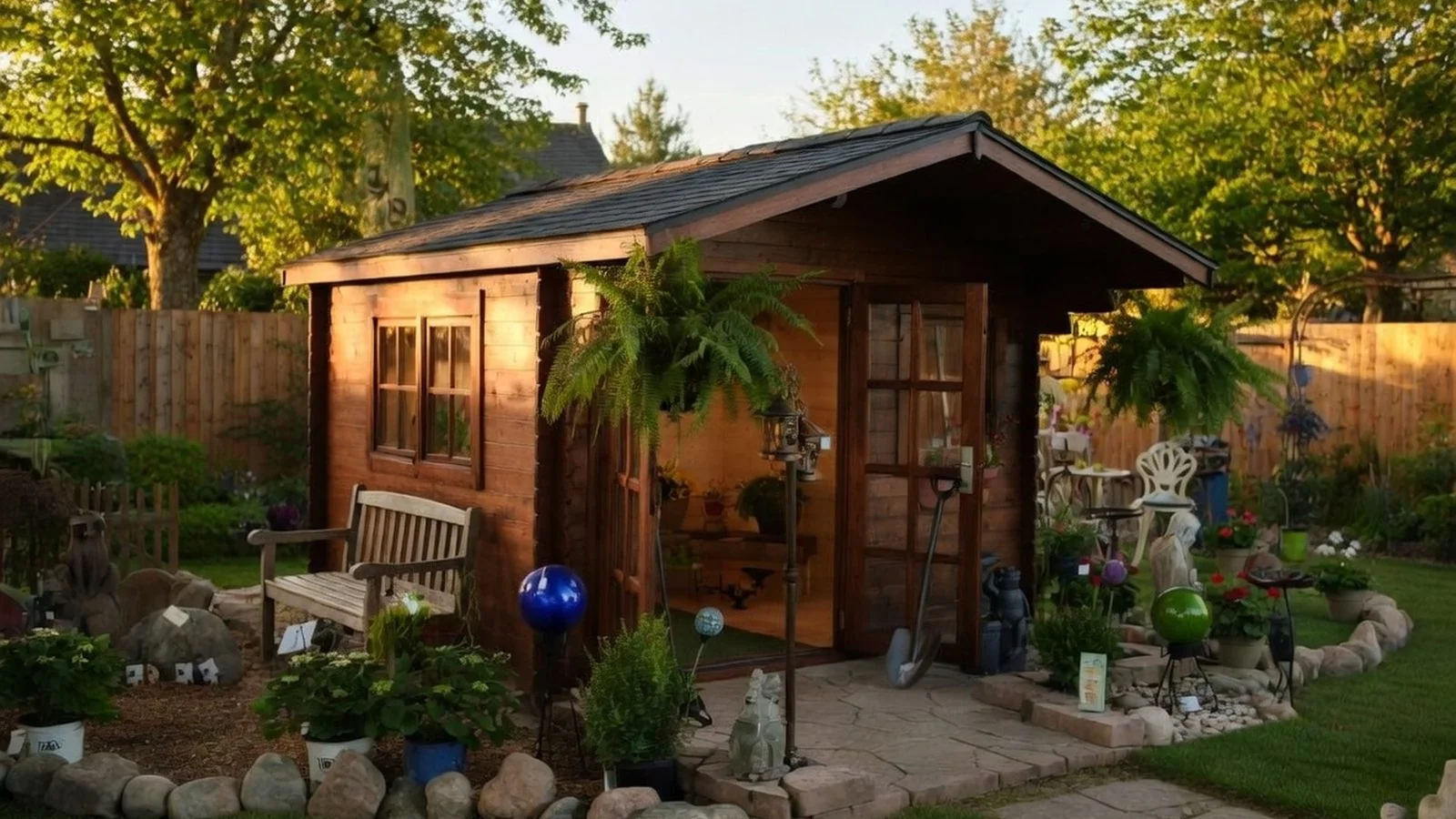
Imagine Lincoln Logs scaled to full size, machined by CNC equipment to half-millimeter tolerances, flat-packed onto a pallet, and shipped to your driveway. That's this category.
Each wall plank is a solid piece of Nordic spruce or pine (typically 90–140mm wide, cut to length for each wall). Along the top edge is a tongue. Along the bottom edge is a groove. At each end is a notch that forms the corner joint. You stack one plank on top of another, rubber-mallet it home, and the tongue-in-groove seal plus the interlocking corners plus the dead weight of the wood form a self-supporting wall. No studs. No OSB sheathing. No framing nails at all. The wall is the structure.
If you've ever played with Lincoln Logs as a kid, you already understand the concept — and that's not a simplification. This is genuinely one of the most beginner-friendly construction methods available. You don't need a nail gun, a framing square, or twenty years of carpentry experience. You stack planks, tap them with a rubber mallet, and gravity plus the interlocking joints do the rest. Compare that to building a 2×4 framed shed, where you're dealing with a pneumatic nail gun, stud spacing on 16-inch centers, plumb lines, and OSB sheathing — skills that take real practice to get right. A first-time builder with one helper can assemble a 10×10 T&G cabin in a single weekend and feel confident about the result.
This is a fundamentally different construction method from the two walls Americans are familiar with:
- A traditional American round-log cabin is built from full-diameter debarked logs with saddle-notch or dovetail corners and chinking between. Rustic, heavy, handmade, expensive.
- A 2×4 framed shed with T1-11 siding is a miniature stick-framed house — a skeleton of studs with plywood siding tacked to the outside. The wood siding is decoration on a hollow frame.
The European T&G cabin is neither of those. The wood is the frame and the skin. There's no hollow cavity inside the wall — just one solid thickness of kiln-dried spruce between you and the weather. That thickness is the single most important number in the entire category, so we'll come back to it in a minute.
Why you've barely heard of these. Ninety-seven percent of new American single-family homes are stick-frame. The entire construction ecosystem — lumber standards, building codes, contractors, inspectors — is oriented around 2×4s on 16-inch centers. The solid-plank wall is the standard backyard building across the UK, Germany, Scandinavia, and the Baltic states, but it's effectively invisible in US big-box retail. No Home Depot, Lowe's, Menards, Costco, or Wayfair carries it as a named category. The main US discovery path for the last five years has been Amazon (where Allwood's Lillevilla kits went viral in 2019) and Pinterest/Instagram screenshots of European gardens that led curious buyers down a Google rabbit hole.
It is, in other words, a real product that millions of Europeans buy every year — and most Americans have never been told exists.
Is a log-style cabin shed actually right for you?
Be honest about which of these three camps you're in. They map to completely different buying decisions.
Camp 1: You want a beautiful backyard building, not a storage box. You already own a house. You've already looked at metal sheds and plastic sheds and the standard wood-frame shed from the big-box store, and everything looked either ugly or generic. You want something that actually adds to the backyard — something a guest would walk over to instead of squinting at. A solid-plank cabin in the 34–44mm wall range is genuinely beautiful in a way a metal or plastic shed can never be. If this is you, this category is probably the right answer. Keep reading.
Camp 2: You want a backyard office, studio, or she-shed that feels like a real room. Remote work didn't go away. The kid's nursery is now your Zoom background. The "backyard office" category exploded after 2020 and is still growing. A 34–44mm T&G cabin, properly insulated and wired, gives you a quiet separate room with natural wood walls, French doors, and tilt-and-turn European windows for about $8,000–$22,000 all-in — cheaper than most garage conversions and far nicer than any storage shed. This is a real use case and this category handles it better than almost anything else in the price range. But read the total-cost section before you commit.
Camp 3: You want the cheapest weatherproof storage box possible. Then don't buy one of these. A 19mm-wall budget T&G cabin from Amazon will look charming on day one and disappoint you by year three — warped roof boards, gaps between planks, and maintenance you didn't sign up for. For pure utility storage at the lowest price, a metal shed, a plastic resin shed, or even a basic 2×4 wood-frame kit is a better match for your actual needs. Our other guides cover those. Come back here when you want beauty or year-round comfort, not when you want cheap.
If you're between Camp 1 and Camp 2, you're exactly the right buyer for this category. If you're in Camp 3, save yourself the money and buy the right tool for the right job.
The one spec that matters: wall thickness
In this category, wall thickness is not a detail. It is the spec. It determines how long the building lasts, how much it warps, how it feels inside, whether you can use it year-round, and whether your warranty is worth anything.
Here's the tier chart you actually need:
| Wall thickness | Realistic use | Lifespan (treated) | Comfort |
|---|---|---|---|
| 19mm (¾") | Summer-only tool storage | 10–20 years | Summer only; warps easily |
| 28mm (1⅛") | Garden studio, hobby space | 15–25 years | About 6–9 months of the year |
| 34mm (1⅜") | The sweet spot for backyard sheds, workshops, studios | 20–35 years | About 8–10 months of the year |
| 44mm (1¾") | Cabin territory — 200+ sq ft offices, year-round rooms | 30–50 years | Year-round in most climates with insulation |
| 58–70mm | Near-residential garden rooms | 50+ years | Full year-round, mild climates without extra insulation |
The critical jump happens at 34mm. At 34mm and above, quality manufacturers machine a double tongue and groove at every seam — two interlocks per joint instead of one. That double groove is what gives these buildings their qualitative difference in weather sealing, structural rigidity, and resistance to wind lifting planks apart. Below 34mm, you have a garden room with single-groove joints. At 34mm, you have a real backyard building — and that's why we call it the sweet spot for shed-scale projects. At 44mm, you're moving into cabin territory: buildings over 200 square feet where the extra wall mass adds meaningful thermal performance and structural heft for larger footprints.
Here's the practical reality: the vast majority of complaints in Amazon reviews, Reddit threads, and YouTube build videos come from buyers who bought a 19mm or 21mm kit on price and discovered too late what "budget wall thickness" means. Warped roof boards. Planks that develop visible gaps after a winter. Doors that bind. A structure that looks great in month one and tired by month thirty.
If your budget cannot stretch to at least 28mm (and ideally 34mm+), this category is the wrong one for you. Not because there's anything wrong with a 19mm kit at the price — it is what it is — but because at that thickness you're buying a summerhouse and expecting a shed, and the mismatch between expectation and product is where people get burned.
If somebody offers you a 44mm building for $4,000, something is wrong. Real 44mm kits from real brands start around $6,500–$8,000 for a small footprint and go up from there. The price is a feature, not a bug.
Norway spruce, Scots pine, and why the wood species actually matters less than you think
Most European T&G kits ship in one of two species: Nordic Norway spruce or Scandinavian Scots pine. A small number of premium products use Siberian larch (denser, harder, more rot-resistant, and significantly more expensive) or thermally modified pine (heat-treated at 185–215°C, chemical-free, roughly 30-year untreated lifespan).
The short answer: Norway spruce, which is what roughly 80 percent of this category is built from, is genuinely good wood. It grows slowly in the short Nordic summers, which produces dense tight-grained lumber. It takes preservative stain well. It accepts screws cleanly. It's light enough that a 10×10 cabin is under 1,400 pounds, which matters for freight costs and for how easily one person can work with it during assembly. What it is not is naturally rot-resistant untreated — none of these woods are — which is why the maintenance section below is non-negotiable.
Siberian larch is genuinely better wood if you can find it and afford it. It is about 70 percent harder than Scots pine, 75–90 percent heartwood on average, and has documented 30-to-50-year untreated lifespans in exterior use. If you're buying a premium garden room and larch is an option, it's worth asking about. But spruce and pine aren't compromises — they're the industry standard for good reasons.
Don't get lost in species debates online. Wall thickness matters five times more than species. A 44mm spruce building will outlive a 19mm larch one.
The finished interior: why this beats a 2×4 frame where it matters most
Here's something most shed guides skip entirely: what the inside actually looks and feels like when you're done.
When you build a traditional 2×4 framed shed and want a finished interior, you're looking at studs → OSB sheathing → vapor barrier → insulation → drywall → tape → mud → paint. That's a real construction project, and the finished result looks like… a small drywall room. It's fine. It's what every room in your house looks like.
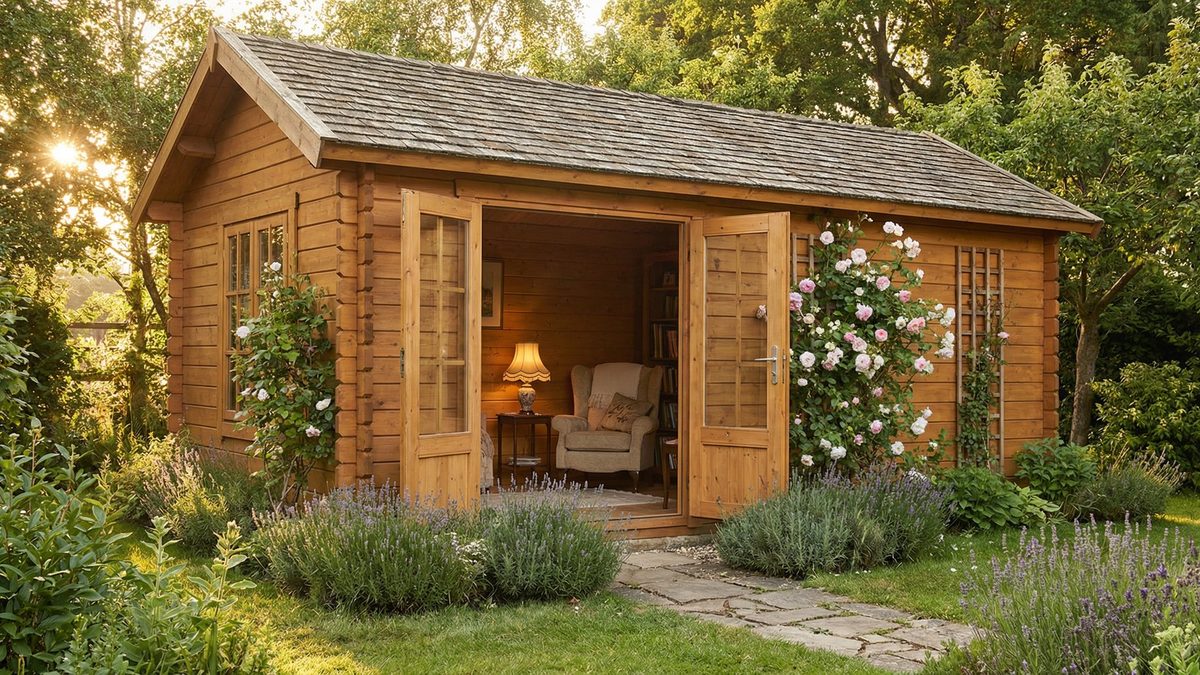
A T&G log cabin gives you a finished interior wall the moment you stack the last plank. The inside of every wall is solid, smooth, kiln-dried spruce — warm to the touch, honey-toned, and genuinely beautiful without a single additional step. No drywall, no taping, no painting. Your "finished interior" is the structure itself.
There's also a health angle worth knowing about. OSB (oriented strand board), which is the backbone of standard 2×4 framed walls, is manufactured using formaldehyde-based resins as the binding agent. In a small enclosed space like a shed or backyard office, off-gassing from OSB can be measurable — especially in hot weather when the building heats up. Low-formaldehyde and no-added-formaldehyde OSB exists, but it costs more and most shed kits don't specify which type they use. A solid-plank T&G cabin has zero OSB and zero formaldehyde binders in the wall assembly. The wall is just wood — nothing else. For a small space where you're spending hours a day, that matters.
And then there's something harder to quantify but very real: the feeling. Log cabins are part of our cultural DNA. From the frontier homestead to the national park lodge to summer camp, the warmth of natural wood walls is something most Americans respond to on an almost instinctive level. When you step into a T&G cabin, you don't feel like you're in a shed — you feel like you're in a cabin. That's not marketing. That's a century of memory built into the material. The scent of spruce, the way light plays across the wood grain, the solidity of the walls under your hand — these are things drywall will never give you.
The hidden problem: kiln-drying and settling
Every European manufacturer kiln-dries their planks before shipping. The target moisture content is typically 12–15 percent. North American kiln-dried lumber is drier still — 6 to 10 percent. This mismatch matters.
If you live in the arid Southwest or Mountain West, your local equilibrium moisture content is around 8–10 percent. European planks arriving at 12–15 percent will dry further after assembly, which causes more shrinkage and more visible checking than a US buyer in a humid region would experience. This isn't a defect. It's just physics. Allow three to six months of acclimatization before applying your final finish coat, and expect to re-tighten any adjustable hardware (storm braces, threaded tie-rods) at six and twelve months.
If you live in the humid Southeast or Pacific Northwest, the planks arrive close to equilibrium and behave more stably from the start.
Either way, a well-made T&G plank shed will settle about 0.5–2 percent of its wall height over the first one to two years. A seven-foot wall may drop half an inch to an inch and a half. Good kits handle this by letting door and window frames float independently of the wall — they sit in oversized openings with a 10-to-15-millimeter gap above so the wall can settle without crushing the frame. Storm braces (vertical threaded rods) are assembled finger-tight and re-tightened twice in the first year.
Cheap kits skip the float-frame detail. When the wall settles, doors bind and window sashes stick. If the kit you're looking at doesn't mention settling clearance or storm braces in its assembly manual, that's a warning sign.
What it really costs (the number nobody wants to tell you)
Here's a worked example using a real case from a published Reddit thread — a SolidBuild Whales 10×10 at 34mm, one of the most popular real-world purchases in this category, documented by a buyer who posted his final numbers:
- Kit price (Whales 10×10, 34mm, delivered) — ≈ $6,395
- Concrete pad foundation — ≈ $1,800
- Roofing shingles (not always included with kit) — ≈ $450
- Exterior stain + brushes + drop cloth — ≈ $300
- Electrical (subpanel, outlets, lighting, run from house) — ≈ $3,000
- Interior insulation + drywall or T&G lining for year-round office use — ≈ $1,800
- Permit fee — ≈ $200
- Misc hardware, trim, shelving, furnishings — ≈ $400
Real total: ≈ $14,345, per the buyer's own post.
That's not a scam. That's what it actually costs to get a 34mm cabin from an Amazon or direct-ship pallet into a finished, wired, insulated, stained, permitted, furnished backyard room.
Now compare that to the Amazon sticker shock story on the other side of the market. A documented Allwood buyer from a well-circulated YouTube series budgeted $15,000 for a finished backyard office and landed at $18,000–$25,000 all-in. Kit at $8,164 on Amazon (already 37% above the direct price from Allwood's own site), plus foundation, roofing, exterior treatment, insulation, electrical, furnishing.
But here's the thing: that $14,345 number represents a full build-out — concrete pad, professional-grade electrical, insulation, drywall interior. Not every project needs all of that. If your goal is a beautiful backyard shed or workshop (not a year-round insulated office), the finish-out costs drop significantly.
Here's what a simpler, practical finish looks like for the same 10×10 34mm kit:
- Kit price (34mm, delivered) — ≈ $6,395
- Simple 2×6 pressure-treated frame foundation (gravel base + ground-contact lumber) — ≈ $400–$600
- Regular asphalt shingles — ≈ $350–$450
- Exterior stain — ≈ $250–$300
- Simple electrical (one circuit run from house panel, a few outlets + lights, DIY-friendly) — ≈ $300–$800
- Permit fee — ≈ $200
Simpler total: ≈ $8,000–$8,750. That's roughly 1.25× to 1.35× the kit price — nowhere near the 2× multiplier. And remember: with a T&G cabin, the interior walls are already finished. You don't need drywall, tape, mud, or paint. You stack the planks and the inside looks like a cabin. That alone saves $1,500–$2,000 compared to finishing a 2×4 framed shed to the same standard.
Run your own numbers: Use our free Project Cost Estimator to plug in your specific choices — foundation type, roofing, electrical, insulation — and see your real all-in cost before you commit.
The honest total-cost rule of thumb: for a full build-out with insulation, electrical, and interior finishing, plan for 1.5× to 2× the kit price. For a simpler shed or workshop finish with a 2×6 frame foundation, regular shingles, stain, and basic electrical, you're looking at closer to 1.25× to 1.4×. The key is knowing which version you're building before you set your budget.
Run your own numbers: Use our free From-Scratch Cost Calculator to estimate a full DIY build, or the Kit Cost Calculator if you're buying a prefab kit.
There is also one systematic savings opportunity worth knowing about: Amazon charges roughly 30 to 45 percent more than direct. Allwood's Escape is $5,950 direct from allwoodoutlet.com and about $8,164 on Amazon. The Claudia is $10,450 direct and about $12,990 on Amazon. Amazon's the place to discover this category. Your phone and the manufacturer's direct site are where you actually buy it.
The 2025–2026 tariff reality (because this matters right now)
If you're reading this in 2026, the tariff situation is worth understanding because it genuinely changes what you should buy:
- The Section 232 investigation on timber and lumber went into effect October 14, 2025, adding a 10 percent base tariff on softwood lumber imports, with European Union origins capped at 15 percent under a July 2025 US-EU political agreement.
- Canadian softwood now faces approximately 45 percent combined tariffs — the pre-existing duties plus the new Section 232 layer. This is the highest tariff wall Canadian lumber has faced in a decade.
- Paradoxical result: European Baltic-manufactured kits (Estonia, Latvia, Lithuania) are now more competitive against Canadian alternatives in the US market than they have been in years. Canadian brands like Summerwood or EZ Log Structures face steeper pricing headwinds than Estonian Palmako or Finnish Lillevilla.
For a $6,000 kit, the Section 232 layer adds roughly $600–$900 in tariff to the landed cost. That's real money but it's not catastrophic at the premium tier. It is catastrophic at the budget tier, which is part of why $3,000 cabin kits are getting harder to find in the US than they were in 2023.
If you see a brand selling well below the rest of the market, ask where it's manufactured and whether the price quoted includes post-tariff landed cost. Some sellers are still moving old inventory at pre-tariff prices. That's a good deal if you catch it. Others are quietly eating the tariff at a margin they can't sustain — which becomes your problem when warranty claims come up.
The 12-year ownership arc
If you buy a real 34mm or 44mm T&G cabin and treat it like the building it is:
Year 0–1: Assembly, foundation, stain coat. Initial settling. Re-tighten storm braces at 6 and 12 months. Your neighbors ask what it is.
Year 1–3: Wood is holding its honey tone well. Stain looks fresh. You use it more than you expected. You've probably added a light fixture, a small heater, maybe a window AC.
Year 3–5: First re-stain due. About $200–$300 in materials, one weekend of labor. If you skip this, the exterior starts silvering from the sun. That's not automatically bad — silver-gray weathered wood is a legitimate Scandinavian aesthetic — but you have to make it a choice, not an accident.
Year 5–8: Second re-stain. Check the base planks (the first one or two courses above the foundation) for any sign of moisture wicking from below. Good foundation prep pays off here.
Year 8–12: The building is now a backyard fixture. If you maintained the stain, it looks about 80 percent as good as day one. If you let it go silver, it looks like it belongs in a Norwegian photo essay. Either is fine. The structure is sound; the wood is solid; the corners still lock together because gravity hasn't stopped working.
A well-bought 44mm cabin should comfortably reach year 20 with this maintenance cycle. A well-bought 34mm cabin should comfortably reach year 15. A 19mm kit will probably be looking rough by year 8 and need serious work by year 12 — which, again, is fine for what it was, as long as you bought it knowing that.
The 5 most common regrets
- "I bought the thinnest walls because it was cheapest." The single most common regret in this category. 19mm walls warp, gap, and disappoint. Don't learn this lesson the expensive way.
- "I didn't budget for the foundation." A level, well-drained, properly elevated foundation is half of whether this building survives. Rushed concrete work or a sloppy gravel pad shows up as binding doors in year two.
- "I bought on Amazon instead of direct." 30-to-45-percent markup on the same kit from the same manufacturer. Discover on Amazon, buy direct.
- "I didn't plan for insulation." Buyers expected their 34mm cabin to feel like a finished room in January and found out that solid spruce has an R-value around 2. It's not the wall's fault — it's an expectation mismatch. Insulate if you want year-round comfort in a cold climate, or accept that it's a three-season room.
- "I assembled it by myself in a rush." Two people working together finish a 10×10 cabin in a day. One person rushing finishes it in two exhausting days and makes mistakes that haunt the next decade. Get a friend, take it slow, level the first course obsessively.
The brand landscape (neutral tour)
This is a young US category with a small number of players and a lot of noise. Here's what you actually need to know:
Allwood / Lillevilla (Finland, sold via Amazon and allwoodoutlet.com) — The viral front door for this entire category in the US. Ranges from the $5,950 Escape (113 sq ft, 44mm) to the $46,900+ Eagle Point (1,108 sq ft, 70mm). The Arlanda and Solvalla series use 19–21mm walls and attract the most complaints; the Escape, Claudia, Bonaire, Getaway, and Bella are 44mm and generally well-reviewed. Critical watch-out: Allwood's warranty is five years on wall elements ≥28mm — the 19mm Arlanda series is explicitly excluded. Read the warranty fine print before ordering any model under 28mm. Amazon prices are 30–45 percent above direct.
SolidBuild Wood (direct-to-consumer at solidbuildwood.com) — A US-facing direct-ship brand with a minimum wall thickness of 34mm across the entire catalog — no 19mm entry-point traps. Models run from the $3,795 Shiba (8×8) through the $8,895 California (44mm) and the made-to-order $18,495 Washington. Notable differentiators include pressure-treated floor joists as standard, double-pane tilt-and-turn European windows, and a US phone line (800-590-2508) for assembly questions — a real advantage over email-only European brands. Trustpilot rating is 4.8/5 from 177 reviews, which is the highest verified rating we've seen in this category in the US market. Watch-out: warranty is 1 year (manufacturing defects). Note: SolidBuild is owned by the same family that owns ShedScout, so treat this entry with the same skepticism you'd apply to any recommendation from an interested party — compare it against Allwood and Palmako on specs and price before deciding.
Palmako (Estonia, sold in the US via outdoorlivingretreat.com) — Estonia's biggest wooden-building exporter. Founded 1997, produces 60,000+ buildings per year, 130+ products in the US catalog. Wall thicknesses span 28mm to 44mm, with named series including Dan (storage sheds), Emma (alpine log cabins), Britta (Swiss chalet), Bret (contemporary), Claudia (clockhouse), and Andrea (garden rooms with sliding doors). US pricing runs roughly $3,100 to $18,700. Deep product range, reliable European engineering, but US support is handled through a distributor rather than direct.
BZB Cabins and Outdoors (US-based distributor) — New Jersey warehouse, ships to all 48 states plus Canada. Authorized Lillevilla dealer, also carries own-brand European kits. 3-year warranty on manufacturing defects. Useful as a US-warehouse option for buyers who don't want to deal with a direct-from-Europe shipment.
Pineca (Lithuania, with US office in Miami) — Family manufacturer founded 1993. Ships direct from Lithuania; 10–15 working days for in-stock models and 3–6 months for made-to-order. Budget tier uses 14mm walls — those are not competitive with anything else in this guide. Mid- and premium-tier Pineca products are worth considering but lead times and European-based support can be frustrating.
EZ Log Structures (Canada) — Interlocking T&G siding over a framed wall. Not a true structural-plank system like the European brands above; more like a Canadian hybrid. Free shipping and structural engineering are included, which matters for permitting. Remember the 45 percent Canadian tariff context when comparing prices against European alternatives.
Summerwood (Canada) and Jamaica Cottage Shop (Vermont) — Both are premium North American brands that show up in log-cabin-shed searches but build differently. Summerwood uses cedar panel/framed construction (not T&G structural planks). Jamaica Cottage Shop uses post-and-beam hemlock. Both make beautiful buildings; both are significantly more expensive than the European T&G kits; both are the right answer if you want handcrafted North American construction rather than flat-packed European engineering.
What none of these are: actual American round-log cabin home builders. Honka, Katahdin, Coventry Log Homes, Tar River Log Homes — those are full-residential companies building $50,000–$500,000 handcrafted log houses. If you want a rustic round-log aesthetic, they make it, but at house prices with house lead times and house permit processes. They're outside the scope of this guide.
When a log-style cabin shed is absolutely right
- You want a genuinely beautiful backyard building, not a utility box, and you care how the space feels more than how little it cost.
- You want a backyard office, art studio, or she-shed in the 34–44mm range and you're budgeting realistically for the finish-out.
- You want a small finished interior space with climate control. A 34mm cabin with a mini-split heat pump is an ideal combination — the mini-split handles both heating and cooling efficiently, the solid wood walls provide some natural insulation, and you get a comfortable year-round room without the complexity of a full insulation build-out. For spaces under 200 square feet, this is one of the best cost-to-comfort ratios in the backyard building market.
- You're a beginner builder. The no-nail, stack-and-lock assembly is dramatically more forgiving than 2×4 framing with a nail gun — making this one of the few building projects where a first-timer can genuinely do it themselves.
- You live in a climate where year-round use either isn't required (California, Pacific Northwest, Southeast) or you're willing to add a mini-split for a cold-climate space.
- You accept that real wood means some maintenance — a re-stain every 3 to 5 years — and you actually want the natural wood warmth that comes with it.
One honest note about full insulation: if your end goal is a fully insulated, code-compliant, year-round living space with plumbing — something closer to an accessory dwelling unit (ADU) — a T&G cabin can be insulated, but at that level of build-out, you may be better served by our Shed-to-ADU Conversion Guide or a purpose-built modern studio shed. The T&G cabin is ideal for a small finished room with a mini-split. For complete insulation with vapor barriers, interior framing, and drywall, the cost and complexity start to close the gap with products designed for that from the ground up.
When to walk away
- You need a cheap utility storage box. Buy metal or plastic. Do not buy a 19mm T&G cabin expecting it to be a shed.
- You expect zero maintenance for 20 years. This isn't the category for that. Go plastic resin.
- You live in a strict HOA that specifically prohibits "log-cabin-style" structures (some do — check your covenants before ordering a cabin that arrives in Estonia packaging).
- Your local permit office has flagged the construction method as "unconventional" and is requiring engineer stamps you don't want to pay for. In some jurisdictions, a standard 2×4-framed wood shed avoids this headache entirely.
- You're trying to beat the total-cost number. Even with the simpler finish approach (2×6 frame foundation, shingles, stain, basic electric), you're looking at $8,000+ all-in for a 10×10. If $5,000 is your absolute ceiling, a basic 2×4 framed shed or a metal shed is the honest answer.
Questions to ask before you buy
- What's the wall thickness — exactly in millimeters? If the listing says "thick walls" or "solid wood construction" without a number, ask for the number. 34mm or 44mm is where quality starts.
- Are the corners single-notch or double-notch? Double-notch is the 44mm-and-up standard.
- What's the kiln-dried moisture content at shipment? 12–15 percent is the European norm. If the seller can't answer, they don't know their product.
- Are floor joists pressure-treated? They should be. If they aren't, plan to treat them yourself before assembly or budget for replacement in year 8.
- Is roofing included or is it extra? Both answers are fine. You just need to know which one before the pallet arrives.
- What's the windows and doors spec? Double-pane glass is standard on quality brands. Single-pane is a budget signal.
- What's the wind and snow load rating? Quality brands publish both. Vague answers are a red flag.
- Is there a US phone number for assembly support? Email-only support from a European office, with an eight-hour time difference, gets old quickly during a two-day assembly.
- What does the warranty actually cover, and which models are excluded? Read the exclusions. This is where buyers get burned.
- What's the real landed price including tariffs? Post-October-2025, ask for landed cost, not FOB.
The bottom line
European-style T&G log cabin sheds are the most underrated product in the US backyard-building market. They solve a real problem — ugly sheds — with real engineering that has been refined across a century of Nordic and Baltic manufacturing. A well-chosen 34mm or 44mm kit from a serious brand, built on a decent foundation and maintained with a re-stain every few years, will look beautiful on day one and still look beautiful on year ten.
They are also the most expensive product in the backyard-building market to get wrong. A 19mm budget kit bought on Amazon because the sticker was attractive is the setup for every disappointed Reddit post and warped-roof YouTube video in the category. The gap between a well-bought cabin and a badly-bought cabin is enormous.
Buy for wall thickness first — 34mm with double tongue-and-groove is the sweet spot for backyard sheds. Budget realistically for your finish level: a simple shed finish runs about 1.25–1.4× the kit price; a full insulated office build-out runs 1.5–2×. Discover on Amazon, buy direct. Compare at least two brands on specs, not just price. Take a weekend to assemble it with a friend — the no-nail Lincoln Log construction means you don't need a nail gun or carpentry experience. Re-stain every few years. And treat it like the small building it actually is, not the disposable shed that its price tag might suggest.
There's a reason log cabins have been part of the American story since the frontier — natural wood walls have a warmth and a feeling that no amount of drywall or vinyl siding will ever replicate. When you step into a well-built T&G cabin, you feel it immediately. That's not nostalgia. That's good engineering meeting a material that humans have lived with for thousands of years.
If you do it right, you'll own the nicest thing in your backyard for about the cost of a used car. If you don't, you'll own an expensive disappointment.
Worth doing it right.
Related ShedScout guides
- Wooden Sheds — The Honest, Deep Guide — 2×4 framed, T1-11 siding, the American standard
- Cedar Sheds — The Honest, Deep Guide — Western Red Cedar options, graying, grades, hidden costs
- Metal & Steel Sheds — The Honest, Deep Guide — Gauge, Galvalume, condensation, honest trade-offs
- Plastic / Resin Sheds — The Honest, Deep Guide — Zero-maintenance, honest about aesthetics
- Modern & Studio Sheds — The Honest, Deep Guide — Five real price tiers, thermal performance, and the brand landscape
- Shed-to-ADU Conversion — The Honest Guide — The four-corner test, state laws, the cost cliff, and when it makes sense
This guide is editorially independent. ShedScout does not accept payment for inclusion in brand round-ups. Where we mention SolidBuild Wood as one option alongside Allwood, Palmako, BZB, and others, we disclose that SolidBuild is owned by the same family that owns ShedScout. Compare it against its peers on specs and price before deciding. That's the whole point of this site.