title: "Shed to ADU — When Your Backyard Building Crosses the Line" slug: shed-to-adu-conversion category: Shed Types & Buyer Guides word_count_target: 5800 voice: honest knowledgeable neighbor last_updated: 2026-04-07
Shed to ADU — When Your Backyard Building Crosses the Line
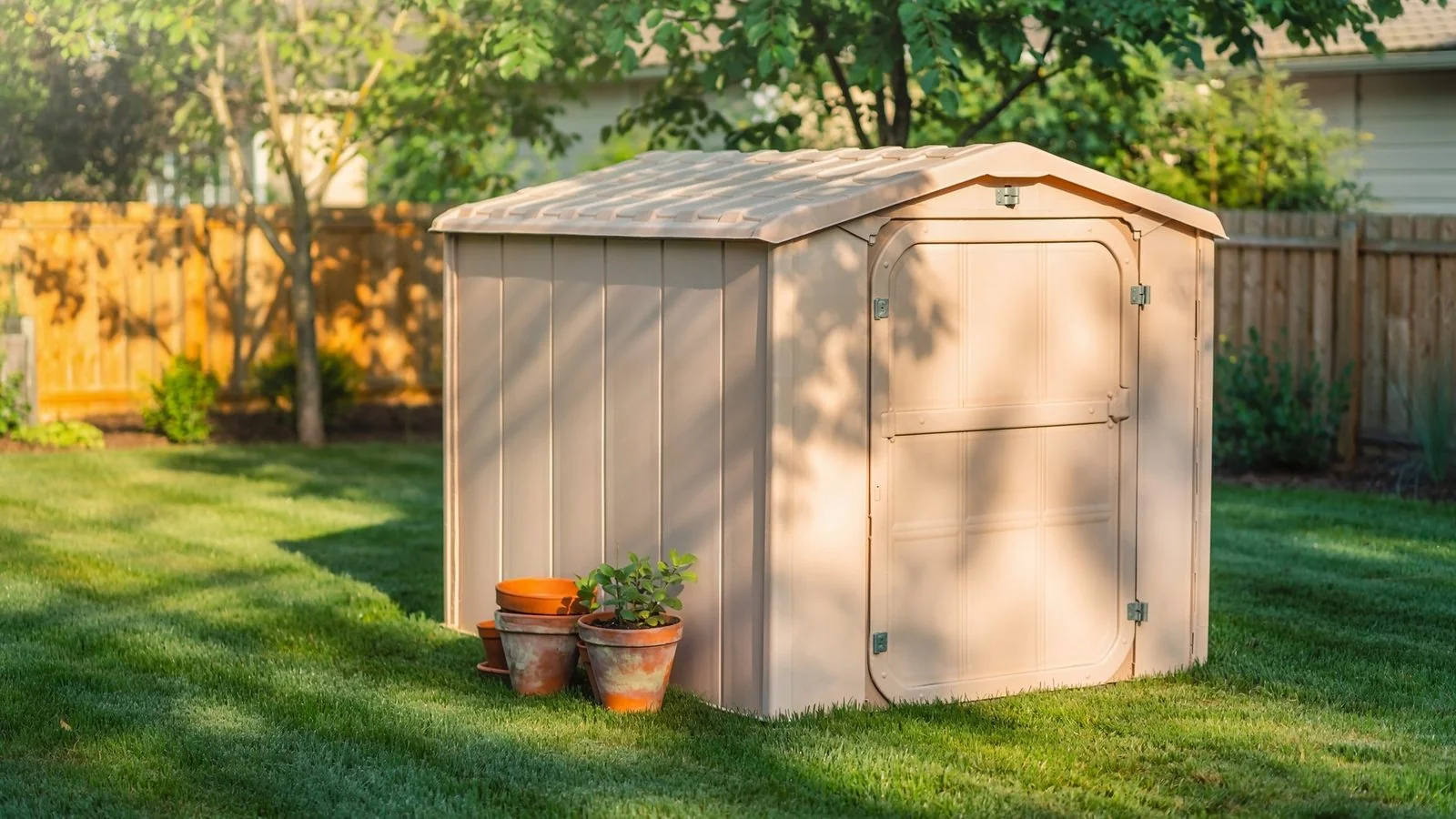
There is a moment in almost every shed shopping journey where the question quietly changes.
It starts as "I need a place to put the mower." Then it becomes "I'd like a little office out there." Then "well, if I'm running power anyway, maybe a mini-split." Then "could my mother-in-law sleep here when she visits?" Then "could I rent it on Airbnb?" And by the time you're standing in your backyard with a tape measure, you're not really shopping for a shed anymore. You're shopping for an Accessory Dwelling Unit — an ADU — and you don't know it yet.
This article is for the person standing in that exact moment. Not the person who already knows they want a full $300,000 prefab ADU from a California specialist. Not the person who just wants somewhere to keep the snowblower. The person in the middle. The person who is looking at a 12×16 cabin kit for $18,000 and wondering, very reasonably, whether that's a clever shortcut or whether they're about to walk into a permitting nightmare.
The honest answer is: it depends, and the line is sharper than the marketing photos suggest. There are real legal triggers. There are real cost cliffs. There are real moments where a $20,000 kit becomes a $90,000 project, and a few moments where it actually doesn't. We are going to walk through all of them.
Why this article exists
Most ADU writing on the internet is written for one of two audiences. There's the audience of people willing to spend $300,000 on a full-service prefab from Abodu or Villa, and there's the audience of people in California who already have an architect lined up. Almost nobody writes for the third group — the homeowner who is shed-curious, ADU-curious, and trying to figure out which side of that line their project actually lives on.
This is the lane ShedScout cares about. We cover sheds for a living. We know the kit market — Allwood, SolidBuild, Tuff Shed, Studio Shed, Heartland, Jamaica Cottage Shop. We also know that some of those products can legally become permitted dwelling units, some of them physically could but never legally will, and some of them shouldn't be anywhere near the conversation. The goal of this guide is to draw the line clearly, without selling you anything, so you can decide which side you're on before you spend a dollar.
A note we'll get out of the way up front, since it matters: SolidBuild Wood is owned by the same family that owns ShedScout. Wherever SolidBuild appears in this article alongside Allwood, Summerwood, Tuff Shed, Jamaica Cottage Shop, Studio Shed, or anyone else, we are mentioning them on the same neutral terms. We do not get paid for inclusion in this list. If a product is wrong for your situation, we will say so regardless of whose name is on the box.
What an ADU actually is (the legal definition that matters)
The phrase "accessory dwelling unit" sounds bureaucratic, and that's because it is. The legal idea behind it is simple: it is a second, smaller, complete living unit on the same lot as a primary house. The word that does most of the work in that sentence is "complete." A space is an ADU when it has, at minimum, four things together:
A place to sleep. A place to cook. A bathroom. An independent entrance from the outside.
If a structure has all four, it is an ADU under almost every code in the country, and your local building department will treat it as a dwelling unit whether you call it that or not. If it is missing even one of those four, it is something else — an office, a studio, a guest room, a pool house, a "hobby shop." That linguistic distinction is not a loophole. It is the actual legal hinge that the entire shed-to-ADU question swings on.
This matters because the moment your backyard structure is treated as a dwelling unit, an entirely different rulebook opens. Different setbacks. Different foundations. Different insulation minimums. Different fire ratings. A full plan check. Utility upgrades. Impact fees. Property tax reassessment on the new structure. A Certificate of Occupancy at the end. Every one of those things has a price tag. We will get to them.
The four-corner test (use this before you do anything else)
Before you read another marketing brochure or click another configurator, do this exercise on paper. It will save you months.
Write down the four ADU triggers: sleeping, cooking, bathroom, separate entry. Then ask yourself, honestly, how many of those you actually need this structure to do. Not "could it conceivably," but "do I plan to."
- Zero or one of the four → you are buying a shed. Stay in the shed market. The whole rest of this article is interesting but not urgent for you.
- Two of the four (typically a sleeping nook + a separate entry, or a half-bath + an office) → you are in the gray zone. You will probably end up needing a permit, but the path is short and the cost is contained.
- Three of the four → you are building an ADU. The kit market can sometimes still get you there, but only with significant added work. Read every section of this article carefully.
- All four → you are unambiguously building a dwelling unit. Almost no off-the-shelf "shed" product is going to land you safely on the other side of this without major upgrades, and many of them will not get you there at all. We will be honest about which ones can.
The reason we lead with this instead of with brand recommendations is that almost every regret in this category comes from someone who answered "two" or "three" with a product that was designed for "zero." The kit didn't fail them. They just bought the wrong kit for the question they were actually asking.
The cost cliff: from shed to ADU in real dollars
Let's talk numbers, because the brochure numbers are not the real numbers, and that's where the painful surprises live.
A common shed-scale kit — say a SolidBuild "Bella" or "Whales" model, an Allwood Bella, a Tuff Shed Premier Pro Studio in the same footprint, a Summerwood Telluride small kit — comes in at a sticker price of about $8,000 to $25,000 for the materials. A real homeowner who actually finishes one of those into a usable, insulated, wired, comfortable backyard room generally lands between $14,000 and $35,000 all-in once you add the foundation, the delivery, the site prep, the electrical run from the house, the mini-split, the interior finish, and the small inevitable extras nobody puts in the configurator.
That is the shed number. That is also the upper limit of the shed market. As long as you have not crossed any of the four ADU triggers, you stay in that range.
The moment you cross into ADU territory, the numbers change shape. You don't add a percentage. You add a category. The same physical structure, on the same physical pad, costs more because of what you're now legally required to do to it. Here is what gets layered on, drawn from real ADU project breakdowns and the standard line items that show up in most permitted ADU budgets we've seen documented:
- Permit fees — somewhere between $2,000 and $15,000, depending on jurisdiction. California's smaller ADUs under 750 square feet have had impact fees waived statewide since 2017, which is one of the only reasons that market exists at all. In most other states, you pay the full freight.
- Plan check and engineering — another $3,000 to $10,000. Stamped drawings showing your structure meets the local energy code (Title 24 in California, IECC elsewhere), your snow load, your wind load, your seismic zone. This is the step where most kit buyers discover their kit isn't engineered for their state.
- Foundation upgrade — kits ship for gravel pads or pier blocks. ADUs almost universally require a permanent foundation. A real concrete slab or frost-protected pier-and-beam typically adds $8,000 to $20,000.
- Utility connections — water, sewer, electrical, sometimes gas. This is the line item that wrecks budgets. Real-world ADU utility costs sit between $15,000 and $50,000 once you're trenching across a yard, possibly upgrading the main panel, possibly tying into a sewer lateral, and almost certainly running a new electrical sub-panel and meter. NEC 210.25(A) requires a separate electrical meter for each dwelling unit, which often means a service upgrade.
- Insulation and energy compliance — the kit's stock insulation almost certainly does not meet the dwelling-unit minimums. Bring R-values up to code: $3,000 to $8,000.
- Bathroom rough-in and finish — $8,000 to $20,000.
- Kitchen — even a "compact kitchen" with an induction cooktop, sink, and small fridge is typically $4,000 to $12,000.
- Property tax reassessment — the new structure (only the new structure, not your main home) gets added to your assessment. A $150,000-of-value ADU adds roughly $1,500 a year in property taxes at a 1% rate. Not a one-time hit, but a permanent line on your bill.
Add it up. A $20,000 kit can become a fully permitted, livable ADU for somewhere between $85,000 and $150,000 once everything is paid for. A consulting study we read recently put the all-in for a 600-square-foot kit-based ADU at $85,000 on the low end and $150,000 on the high end, with $95,000 as a realistic middle for the SolidBuild-style kit path specifically. Compare that to the $230,000 to $430,000 a full-service prefab usually runs in California, and $180,000 to $280,000 for a stick-built ADU built by a local general contractor, and you can see why the kit path exists. It is genuinely cheaper. It is just not as cheap as the kit's marketing page suggests.
Where the kit market actually fits
Once you understand the cost cliff, the question stops being "is the kit a good deal?" and becomes "where in the spectrum does the kit actually live?" Here is the honest map:
$9,000 to $26,000 — the Amazon cabin kit tier. This is Allwood, Lillevilla, the cheap end of the import cabin market. These kits ship from Estonia or Latvia in flat-pack form. They are real wood, they look great in photos, and they are essentially never able to become a permitted ADU without enough rework that you would have been better off buying something else. The most-cited reason is that they ship at 28mm or 44mm wall thickness with no insulation cavity, no engineered drawings for U.S. building codes, no provision for U.S. electrical, and no customer support for U.S. building department questions. They are wonderful sheds, garden offices, hobby spaces, and uninsulated guest rooms. They are not a path to a permitted dwelling unit in most jurisdictions, and the people who try usually end up replacing them.
$15,000 to $30,000 — the engineered kit tier. This is the gap where SolidBuild Wood positions itself, and where Summerwood (with the Cheyenne and Telluride lines), Jamaica Cottage Shop, and a couple of regional builders also operate. These products are designed to U.S. building codes, ship with engineered drawings, and can in many cases be permitted as either a habitable office or, with the right finish-out package, a small ADU. The crucial nuance: the kit is the shell. You still need a contractor for the foundation, the utilities, the interior finish, and the bathroom and kitchen rough-ins. The kit doesn't shortcut those steps. It just gives you a solid, code-aware shell at a price point that nobody else hits. As a category we like the engineered kit tier as the honest middle path, and we have been transparent that SolidBuild is a family-owned product. Other names in this tier are real options too, and you should price all of them.
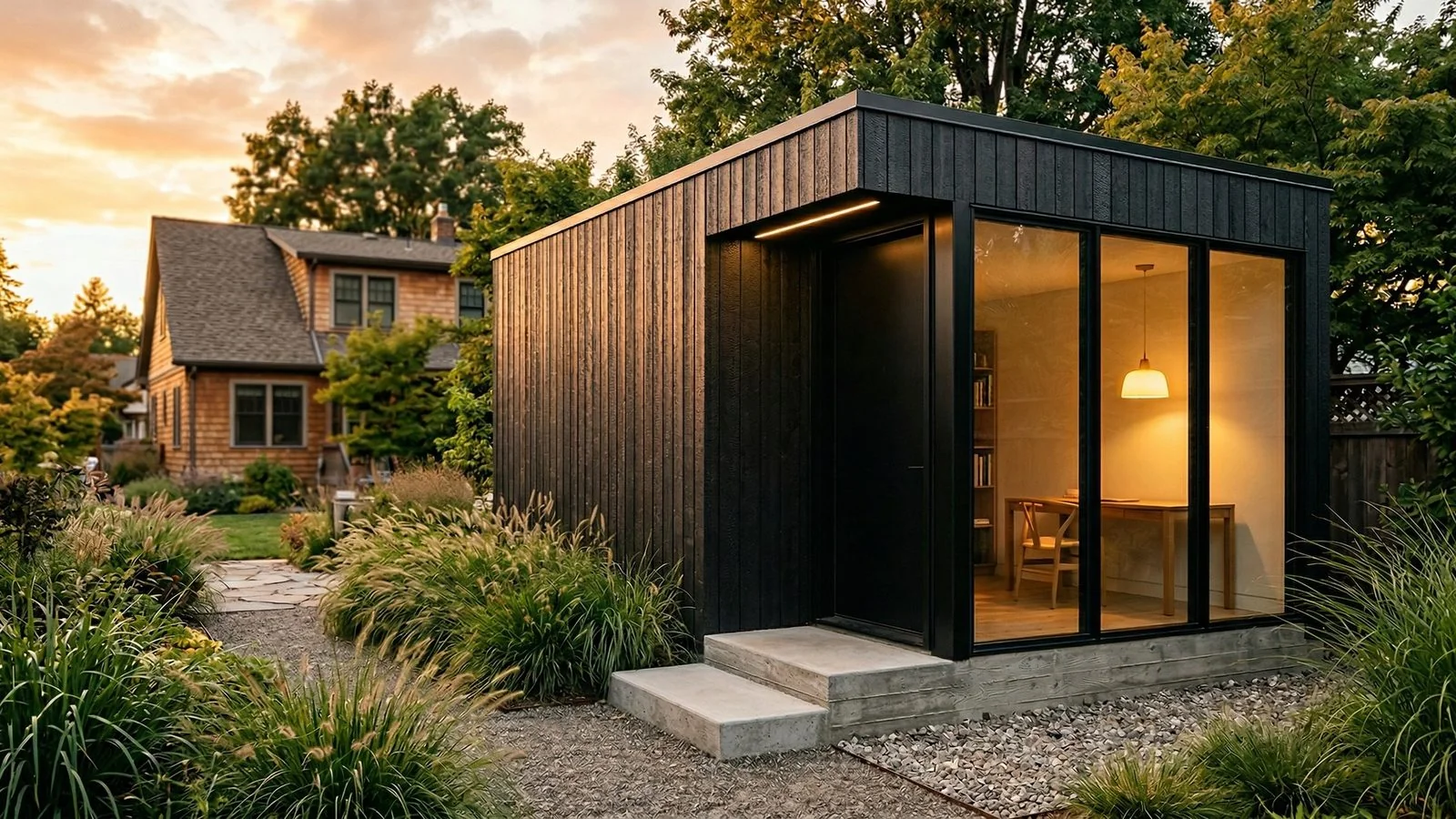
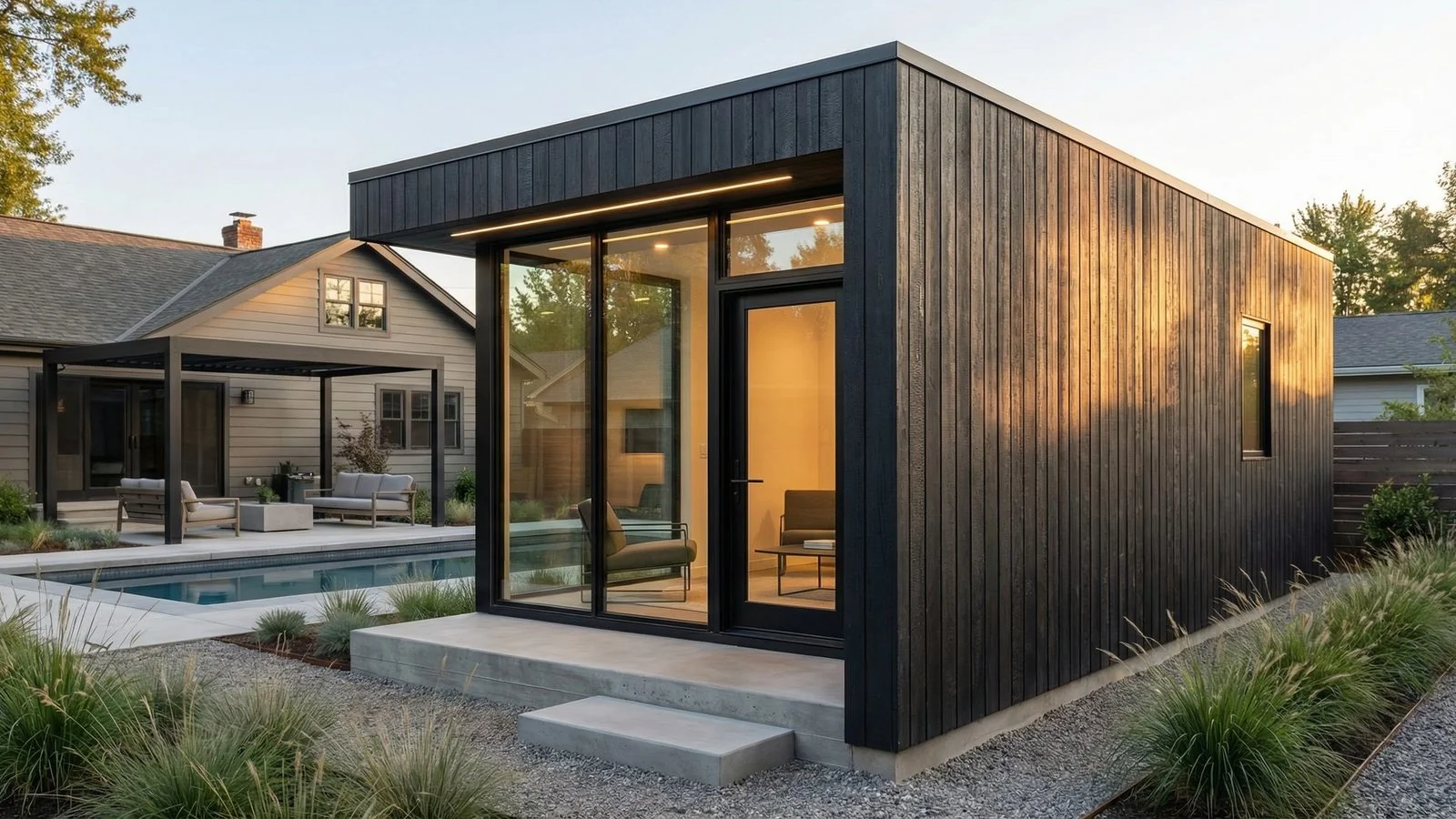
$22,000 to $50,000 — the modern studio shed tier. Studio Shed, Modern-Shed, Kanga, Den Outdoors, and a few others. These products are designed to be backyard offices and studios, not legally distinct dwelling units, and most of them come with explicit guidance that they should not be permitted as ADUs in their stock configuration. They will get you to a beautiful "office or studio" within a single permit cycle in most jurisdictions. They are not the most efficient path if you have decided you actually need an ADU.
$130,000 to $280,000 — kit-to-finished, all in. Summerwood's larger cabin lines, SolidBuild's premium configurations finished by a contractor, Jamaica Cottage Shop at the upper end. This is where you stop comparing to "what would a shed have cost" and start comparing to "what would a stick-built ADU have cost." A finished kit ADU at this price point is typically saving you $50,000 to $150,000 versus a stick-built equivalent, mostly through faster timelines and reduced labor.
$200,000 to $500,000+ — full-service prefab. Abodu, Villa, Cottage, Samara, Connect Homes, Cover, Acton ADU. These companies handle everything: design, permitting, foundation, install, utilities, finish. You write a check, they hand you keys 11 to 18 months later. They are excellent and they are expensive. They are also, almost without exception, only available in California and a handful of other West Coast metros. If you live in Ohio, this tier is mostly irrelevant to you.
The kit tier exists because of a genuine market gap, not because of marketing cleverness. There is real daylight between "Amazon cabin you can't permit" and "Abodu Studio for $300,000," and that daylight is where shed-curious ADU shoppers actually live.
Run your own numbers: Use our free From-Scratch Cost Calculator to estimate a full DIY build, or the Kit Cost Calculator if you're buying a prefab kit.
The state laws that change everything
You cannot have this conversation without talking about state law, because the same physical project is a routine permit in one state and a six-month bureaucratic war in another. Here are the patterns that matter, current to the laws on the books as of early 2026:
California is the country's most aggressive ADU-permissive state. As of 2024, owner occupancy requirements have been permanently eliminated statewide. Local jurisdictions are required to approve ADU permits within 60 days. ADUs up to 1,200 square feet are allowed by right on most single-family lots, with state-mandated minimums of 800 square feet you can build even if local rules try to stop you. Impact fees are waived for ADUs under 750 square feet. Pre-approved plans are mandatory statewide as of January 2025. HOAs cannot unreasonably restrict ADUs, even in CC&Rs that explicitly prohibited detached structures. AB 2533, effective 2025, gives amnesty to unpermitted ADUs built before 2020 if they meet basic health and safety. If you live in California and you've been wondering whether the door is open, the answer is yes — it is the most open it has ever been.
Oregon removed single-family-only zoning statewide in 2019 with HB 2001. ADUs are by-right in residential zones. No parking required within urban growth boundaries. No owner occupancy required. Portland allows them beside duplexes.
Washington passed HB 1337 in 2023 allowing two ADUs per lot statewide, capped impact fees at 50%, and guaranteed a minimum 1,000-square-foot ADU even where local rules try to limit it. Washington also offers a three-year property tax exemption for new ADU construction, which is one of the most generous incentives in the country.
Colorado passed HB 24-1152 in 2024, mandating statewide ADU allowance, putting $13 million in state financing on the table including $5 million in fee reduction grants, and voiding HOA restrictions on ADUs as a matter of public policy. Effective June 2025.
Arizona passed HB 2720 in 2024 requiring cities of 75,000+ to allow two ADUs per lot via ministerial review, with no parking required and no owner occupancy.
Massachusetts passed the Affordable Homes Act in 2024 allowing ADUs by right up to 900 square feet in most of the state (Boston is developing its own rules separately).
Texas has no statewide ADU mandate. Austin's HOME Initiative (December 2023) allows up to three units per single-family lot with a 2,500-square-foot minimum lot size. Tiny homes under 400 square feet are classified as ADUs in Austin. Short-term rental of ADUs built after October 2015 is capped at 30 days a year in Austin specifically.
Florida has no unified statewide ADU mandate. Local rules govern almost everything. The Live Local Act of 2023 created some property tax exemptions for ADUs serving lower-income tenants, but the on-the-ground experience varies enormously by county.
New York City passed City of Yes in 2024, the first NYC ADU zoning definition. It is genuinely new ground for the city.
The local-control-only states — Florida, Georgia (until HB 1166 passes), Idaho, Illinois, Michigan, Minnesota, Ohio, Tennessee, Texas, Virginia, Wisconsin — vary city by city. You will need to call your county planning department before you do anything else.
The practical takeaway: if you live in California, Oregon, Washington, Colorado, Arizona, or Massachusetts, the legal door to a shed-to-ADU project is open and the path is real. If you live anywhere else, the project is still possible in most cases, but the path is local, bespoke, and usually slower.
The size question: the JADU and the 500-square-foot line
There is a specific subcategory of ADU that matters a lot in this conversation, and almost nobody outside of California knows about it. It is called a Junior ADU, or JADU.
A JADU is an ADU under 500 square feet. Its rules are looser. In California specifically, a JADU is allowed in addition to a regular ADU on the same lot, doesn't require a separate sewer connection if it's an internal conversion, and is generally cheaper and faster to permit. It can have its own entrance and a small efficiency kitchen, and in many cases the bathroom can be shared with the main house.
Why this matters for shed shoppers: 500 square feet is exactly the upper end of the larger shed-and-cabin kit market. A 16×30, an 18×24, a 20×24 — all of those are JADU-sized. If you are a California homeowner doing the four-corner test and answering "yes" to all four triggers, the JADU path is almost certainly the cheapest, fastest legal option for you, and many of the engineered kits in the $15,000–$30,000 range fit naturally into that footprint.
Outside California, the under-500-square-foot threshold matters in a different way. Many local jurisdictions have a "small accessory structure" exemption that lets buildings under a certain square footage skip plan review entirely — sometimes 120 square feet, sometimes 200, sometimes 400. That exemption applies only if the structure is not a dwelling. The moment it has a kitchen and a bathroom, the exemption disappears and you're back in the full ADU rulebook. So small footprint can help with a shed; it doesn't help with an ADU.
The 12 fears (and which ones are real)
Anyone who reads enough homeowner forums knows that the same fears come up again and again before someone commits to an ADU project. We pulled the most common ones from a recent ADU consumer research report, ranked them by how often they appear and how often they actually come true, and here is the honest version.
Cost overruns. This one is real and severe. Real-world ADU projects routinely come in 30 to 50 percent over the homeowner's first budget, and the most expensive surprises are utility costs and unforeseen site work. The kit path mitigates some of this by fixing the shell cost up front, but it doesn't help with utilities or site prep. Plan for 40 percent above your gut number, and get utility quotes before you commit.
Permitting nightmare. Real, especially outside the strong-ADU states. Real homeowners have reported 6 to 15 month permit timelines in jurisdictions without by-right ADU rules. In strong-ADU states, the legally mandated 60-day clock has cut this dramatically. Use your state law as a tool — if your jurisdiction is dragging its feet past the legal mandate, you can escalate.
Contractor fraud / abandonment. Real, and devastating when it happens. The Anchored Tiny Homes collapse in Sacramento in 2024 left customers out roughly $100 million in deposits. The general rule: never pay more than 10% up front, never pay for materials not yet on site, always check the contractor's license status with your state board, and always require lien releases before progress payments.
Financing confusion. Real but solvable. HELOCs are the most common path (used by about 56% of ADU homeowners according to the research), cash is second (about 62% — many homeowners use both). FHA 203(k) and Fannie Mae HomeStyle now allow ADU rental income to count toward qualifying income, which is a meaningful change as of March 2026.
Neighbor anxiety / HOA fights. Mostly overblown in strong-ADU states where state law preempts HOAs. Real in local-control states. Document everything in writing.
Resale uncertainty. Largely overblown. The data shows ADU-equipped homes selling at roughly a 35% premium nationally, with FHFA data showing 7.20% annualized appraised value growth for ADU properties versus 6.25% for non-ADU properties from 2013 to 2023. This fear is the one that most reliably resolves itself once the project is done.
Utility delays. Real and underestimated. PG&E has been documented taking six months for new electrical service in California. Your first call should be your utility, not your contractor.
Foundation surprises. Real for older properties on sloped lots. A geotechnical report is $1,500 to $3,000 and will save you $20,000 in surprises.
Insurance. Real but boring. Most homeowner policies need a rider for the ADU. Costs roughly $100–$300 a year. Not a project killer.
Property tax. Real and permanent. California's blended assessment (SB 1164) means only the new structure is reassessed, not the whole property. A $150,000 ADU adds roughly $1,500 a year. Other states vary; ask your county assessor.
Rental management. Real if you're going to short-term rent it, mostly fictional if you're long-term renting it. Long-term tenants are by far the lower-overhead path.
The "unpermitted shortcut" temptation. Don't. An unpermitted ADU appraises at zero. It complicates every future home sale. It can trigger forced demolition orders, fines of $100 to $1,000+ per day, and in some jurisdictions, insurance and mortgage problems. California's amnesty (AB 2533) helps with pre-2020 units only. New construction has no amnesty path. The path through is the legal path.
Real ownership cost over 10 years
If you've made it this far, you probably want to see the math on whether any of this is worth it. Here is the cleanest version we can give you, using a kit-based ADU as the example because that's where ShedScout's audience actually lives.
A 600-square-foot kit ADU finishes for roughly $95,000 all in (kit, foundation, utilities, finish, permit). Financed with a $95,000 HELOC at 7.5% over 20 years, the monthly payment is about $766. Add roughly $125 a month in property tax increase, $75 a month in insurance, $90 a month in maintenance, and $90 a month in vacancy reserve. Carrying cost: roughly $1,146 a month.
Rent that ADU for $1,800 a month long-term (the national average for a small ADU sits between $1,500 and $1,800; coastal California sits higher) and the net cash flow is about $654 a month, or roughly $7,848 a year. That's about 8.3% cash-on-cash return, which is competitive with most rental real estate.
Add the equity build — a $95,000 ADU typically increases home value by roughly $130,000 to $150,000 at a 35% ADU premium — and the first-year total return on the project lands somewhere around 60%. That number sounds aggressive and it is, because it includes one-time appreciation, not recurring cash flow. The recurring cash flow number — the one you should plan around — is the 8% to 12% range, which is solid but not magical.
The break-even on the project, ignoring appreciation, is roughly 9 to 12 years for most kit-based ADU configurations. If you're planning to stay in the house another 15+ years, the math gets clearly favorable. If you're planning to sell within five years, you're betting more on the resale premium than the rental income, and that bet is reasonable but not certain.
When the kit path makes sense (and when it doesn't)
The "should I" question doesn't have one answer, it has six conditions on each side. You don't need to meet all of them. You just need to look at your honest situation and see which side you're on.
The kit-to-ADU path is the right call when:
- You live in a strong-ADU state — California, Oregon, Washington, Colorado, Arizona, Massachusetts — where the legal door is open and the timelines are predictable.
- Your lot is reasonably flat, has straightforward utility access, and isn't in a flood zone or fire severity zone.
- You plan to stay in the house at least 8 to 10 years so the math has time to work.
- You can self-fund or finance at least $100,000 without straining your monthly budget.
- You want either rental income or a multigenerational living solution, and "more storage" is not on your list of reasons.
- You are willing to act as your own general contractor or hire a small contractor for the finish work — kit ADUs reward homeowners who stay involved.
Walk away from the project (or stay in the shed market) when:
- You live in a local-control state where ADU permitting takes 12+ months and the rules change every council meeting.
- Your lot is sloped, your utilities are far from where you want to put the structure, or your sewer is septic.
- You're planning to sell within the next five years and need the project to pay for itself in cash flow before then.
- You don't actually need a kitchen, a bathroom, sleeping space, and a separate entrance. If you only need two of those, build a beautiful office or studio instead. It will cost a third as much and stress you out a tenth as much.
- Your HOA is hostile and you live somewhere state law doesn't preempt them.
- You are buying the project for the rental income alone, with no other use case. ADU rental returns are good, not extraordinary, and you can usually do better with a stock index fund if pure financial return is the only goal.
Most shed-curious ADU shoppers we hear from are in the gray zone — they want some combination of two or three of the four ADU triggers, but not all four. For most of those people, the right answer is not "build an ADU" but "build a really nice insulated, wired, plumbed-but-not-kitchen office or guest studio that you don't permit as a dwelling unit." That's a $25,000 to $50,000 project. It does 80% of what they actually need and skips 95% of the regulatory cost.
Questions to ask before you spend a dollar
Print this list. Sit with it for a week. Don't talk to a salesperson until you have answers to all of them.
- Which of the four triggers (sleep, cook, bathroom, separate entry) do I actually need this structure to do? Not "would be nice." Need.
- What state and city am I in, and what is the current ADU rulebook there? Call the county planning department. Don't trust a blog.
- Where is my electrical panel, what amperage is it, and what would a service upgrade cost? Get a quote from an electrician before anything else.
- Where is my sewer main / septic field, and how far is it from where I want to put the ADU? Trenching costs more than people think.
- How long is the utility company's queue for new residential service in my area? Call them, not your contractor.
- What is my water table and frost depth, and what does that mean for the foundation?
- Is my lot in a flood zone, fire severity zone, coastal zone, or historic district? Each one adds rules.
- Do I have an HOA, and does my state preempt HOA restrictions on ADUs?
- What's my realistic 10-year hold horizon on this house? If under 5, reconsider the project.
- If everything went 40% over budget, could I still finish? If the answer is no, you need a smaller project.
- Am I actually willing to be a landlord — screening tenants, fixing midnight problems, dealing with vacancy? If not, the rental income math doesn't apply to you.
- Have I gotten three written quotes for the finish-out portion of the project (foundation + utilities + bath + kitchen + interior) so I know what the kit shell is not covering?
The brand landscape, honestly
Here is who shows up when you start shopping in this category, with the honest take on each.
Allwood / Lillevilla. Beautiful Estonian and Latvian cabin kits sold through Amazon at $9,000 to $26,000. Real wood, real construction. Almost never permittable as an ADU in the United States in stock form because the wall thickness, insulation provision, and engineering documentation aren't aligned with U.S. building codes. Excellent backyard offices and garden rooms. Not an ADU shortcut. We've heard this directly from too many homeowners who tried.
SolidBuild Wood. The kit tier we've been describing. $15,000 to $30,000 for the engineered kit, with U.S. code-aware drawings and a product line designed for the kit-to-ADU market specifically. Family-owned product, owned by the same family that owns ShedScout. We mention this every time we mention them. Real value if your project actually fits the kit-shell-plus-contractor model. Not a fit if you need a turnkey done-for-you experience.
Summerwood. Canadian custom builder with the Cheyenne, Telluride, Sonoma, and Nomad lines. Kit prices range from $14,000 to $128,000+. Strong reputation. Genuinely customizable. The larger lines cross into ADU territory comfortably. Slower lead times than Allwood but vastly better engineering documentation.
Jamaica Cottage Shop. Vermont builder with cabin and small-house kits from $15,000 to $104,000+. Strong New England reputation, ships nationally. A real option for the kit-ADU path on the East Coast.
Studio Shed. Louisville, Colorado. The premium modern backyard office category leader. Aspect, Summit, and Signature lines. Beautiful product, SIP construction, $14,000 to $50,000+ kit prices, $30,000 to $80,000+ finished. Designed and marketed as backyard offices, not ADUs. Some configurations can be permitted as ADUs in California specifically; almost nowhere else without significant added work.
Modern-Shed. Seattle. Similar positioning to Studio Shed. Office Shed and Studio Shed lines. Same caveats about ADU permitting.
Tuff Shed Premier Pro Studio. The big-box modern entry. $8,000 to $25,000. Designed for storage and hobby use. Possible to upgrade for office use. Not a realistic ADU path.
Kanga Room Systems (Austin), Den Outdoors (DIY plans + kits), Backcountry Hut Company (Vancouver). All are interesting niche players in the modern studio space, all the same caveats.
Abodu, Villa, Cottage, Samara, Connect Homes, Cover, Acton ADU. The full-service prefab tier. $200,000 to $500,000+. If you can afford it and you live in California or another covered metro, they handle everything, and many homeowners report it was worth the premium for the reduced stress. Not a kit alternative. A different category entirely.
Bottom line
If you came to this article wondering whether you should buy a $20,000 kit and turn it into a guest house, the most honest answer we can give you is: it depends on which side of the four-trigger line your project actually lives on, and most projects live closer to that line than the buyer initially thinks.
If you only need two of the four, build an insulated office or guest studio. Don't permit it as a dwelling unit. Save $50,000.
If you need three of the four, you're either going to upgrade the project into a permitted ADU or you're going to fudge it and live with the legal exposure. Don't fudge it. Either upgrade or step back.
If you need all four, the kit path is real, it's cheaper than full-service prefab, and it's roughly $85,000 to $150,000 finished depending on your state, your utilities, and your finish level. It is not the $20,000 sticker price the kit page shows. The $20,000 is the shell. Plan for the rest.
The states that make this easy are California, Oregon, Washington, Colorado, Arizona, and Massachusetts. The rest of the country is doable but slower.
The single best thing you can do before spending a dollar is call your county planning department and your electric utility, in that order, and have a two-question conversation with each one. "What do I need to build a small dwelling unit in my backyard?" and "How long is your current queue for a new residential electrical service?" Those two answers, more than anything else in this article, will tell you whether this project belongs in your future.
Whatever you decide, decide it with your eyes open. The shed-to-ADU question is one of the few places in homeownership where the marketing photos genuinely don't match the math, and the homeowners who get hurt are almost always the ones who didn't know there was math to do.
Disclosure: ShedScout does not accept payment for inclusion in brand round-ups. SolidBuild Wood is owned by the same family that owns ShedScout.com — when we mention SolidBuild alongside Allwood, Summerwood, Jamaica Cottage Shop, Studio Shed, Tuff Shed, or any other brand, we disclose that relationship. We have no affiliate or referral arrangement with the other brands listed in this article. The cost figures, regulatory information, and ROI calculations are drawn from publicly available consumer and trade research, real homeowner project breakdowns, and state law as of early 2026. Building codes change. Verify with your local jurisdiction before spending money.
Last updated: April 2026.